☰ Table of Contents
You need a machine for dirt work. Two main options exist. A motor grader or a bulldozer. The Motor Grader vs Bulldozer debate is the question every contractor asks before starting a project.
Both push dirt. Both work on heavy job sites. But they are entirely different machines. If you want to dive deep into graders specifically, check out our Motor Grader Complete Guide.
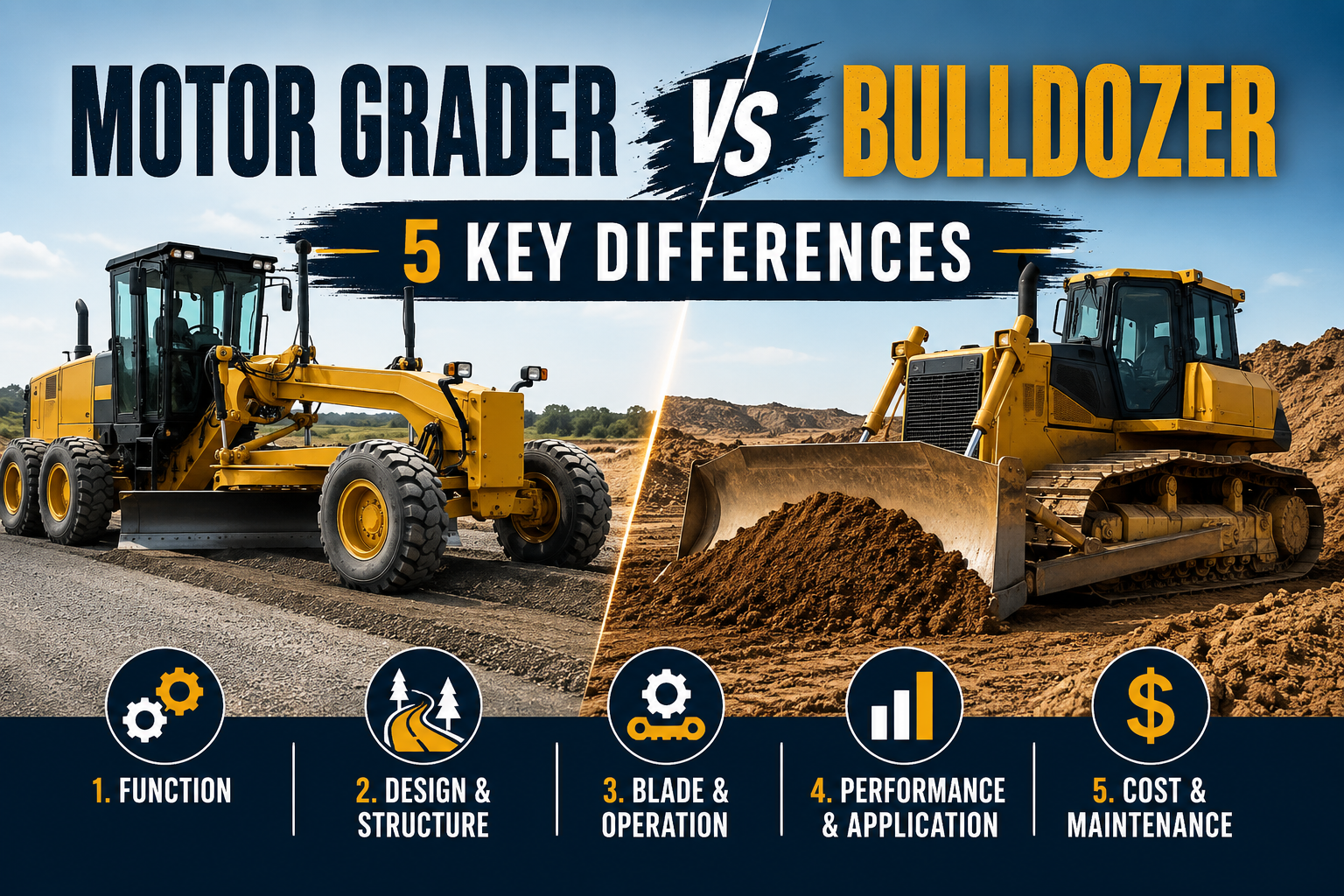
This article gives you a full Motor Grader vs Bulldozer comparison, highlighting 5 key differences with real numbers and examples. Let’s start.
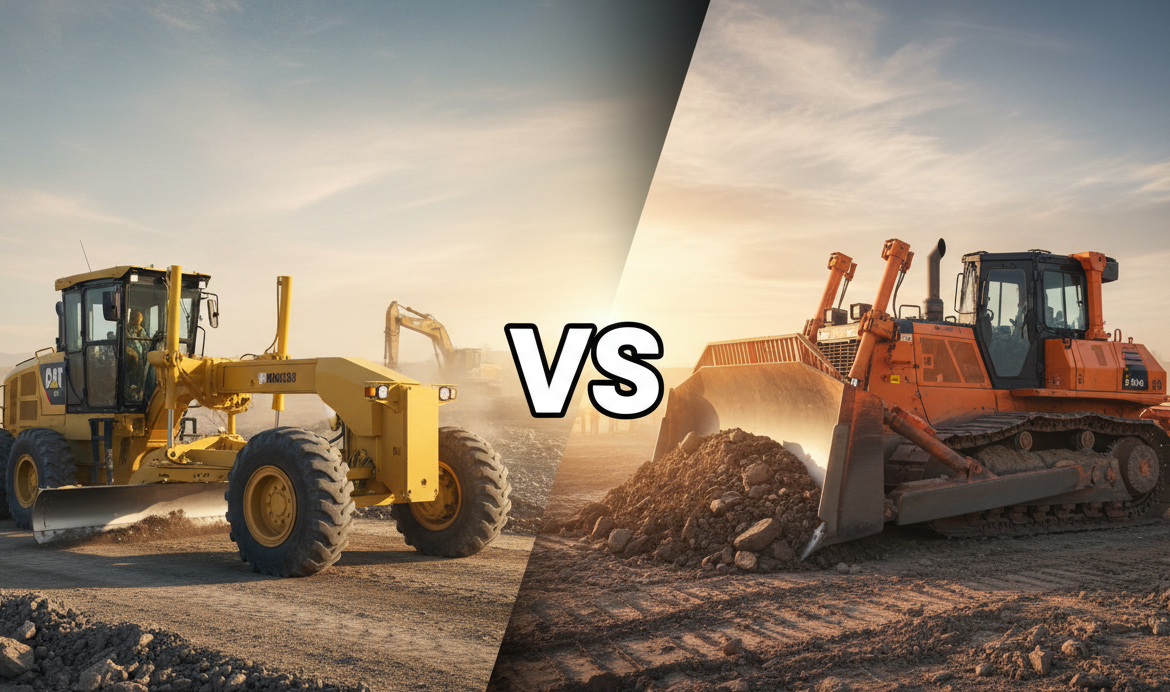
The biggest difference in the Motor Grader vs Bulldozer comparison is the blade position.
A motor grader has a blade mounted between the front and rear wheels. The operator sees the blade clearly from the cab. The blade angles left or right, and tilts forward or back. You create flat surfaces with incredible, precise control.
A bulldozer has a blade mounted on the front of the machine. The operator looks over the blade. The blade primarily lifts up and down and pushes dirt straight forward. You use it to move large amounts of material quickly.
Accuracy Difference:
• A grader blade cuts within a quarter-inch (0.25″) of the target grade.
• A dozer blade cuts within 2 inches of the target grade.
In the Motor Grader vs Bulldozer battle for accuracy, the grader wins easily.
Looking at Motor Grader vs Bulldozer, there is an obvious difference in physical shape.
A motor grader is long and low. A typical grader measures 20 to 30 feet long. Three separate axles hold the machine, and this long frame allows it to ride smoothly over bumps without translating that bounce to the blade.
A bulldozer is short and tall. A typical dozer measures 12 to 18 feet long. Two heavy tracks support the machine. Because of the short frame, the machine rides over each bump, which affects the blade’s level.
The grader works best for smooth finish grading. The dozer works best for pushing heavy loads. This is a key deciding point in Motor Grader vs Bulldozer.
When discussing Motor Grader vs Bulldozer, we must talk about traction and ground contact.
A motor grader uses rubber wheels. The rear wheels drive the machine while the front wheels steer. Rubber grips asphalt and concrete well, meaning wheels do not harm finished pavement. Plus, a grader can easily travel at 25 miles per hour between job sites.
A bulldozer uses heavy metal tracks. These tracks spread the machine’s massive weight over a large area, allowing the dozer to climb steep slopes up to 30 degrees and push straight through deep mud.
While a dozer confidently climbs a 30-degree slope, a grader is limited to about a 15-degree slope. In the Motor Grader vs Bulldozer matchup for rough terrain and slopes, the dozer is the clear winner.
Understanding Motor Grader vs Bulldozer comes down to the practical jobs they perform on site.
A motor grader specializes in finish grading. Use it after the rough work ends. The grader spreads gravel on road bases, creates smooth surfaces for asphalt, cuts V-shaped drainage ditches, and maintains existing gravel roads.
A bulldozer handles rough grading. Use it first on a site. The dozer clears trees, pushes heavy topsoil, digs basements, and builds large earthen berms.
Real Example — Building a 1-Mile Road:
First, start with a bulldozer. Clear the trees, push out the rough shape, and move 10,000 yards of heavy dirt.
Then, bring in a motor grader. Spread the gravel base, crown the road for drainage, and finish the surface perfectly.
When looking at Motor Grader vs Bulldozer, you quickly realize you often need both. One cannot replace the other.
The Motor Grader vs Bulldozer difference that affects your pocket the most is operating cost.
- Fuel: A motor grader burns less fuel. Running a grader for 8 hours uses roughly 20 gallons of diesel. A bulldozer burns much more. Running a dozer for 8 hours uses about 50 gallons. At $4 per gallon, a grader costs $80 per day in fuel, while a dozer costs $200 per day. In Motor Grader vs Bulldozer, the grader is cheaper to run daily.
- Wear Parts: A motor grader runs on tires. Good tires last around 2,000 hours, and four new tires cost about $8,000 (Cost per hour is $4). A bulldozer runs on tracks. Tracks last about 1,500 hours, and an entire new undercarriage costs around $15,000 (Cost per hour is $10).
Ultimately, in Motor Grader vs Bulldozer, tracks are significantly more expensive to maintain than tires.
The Motor Grader vs Bulldozer decision depends entirely on your specific job.
Pick a Motor Grader For:
- Building a gravel driveway
- Paving a parking lot
- Maintaining a dirt road
- Grading a building pad
- Cutting drainage swales
- Fine grading for asphalt
Pick a Bulldozer For:
- Clearing raw land
- Digging a pond
- Pushing heavy stockpiles
- Building a berm
- Backfilling foundations
- Ripping hard, unbroken ground
Real Example — A 5-Acre Building Site:
A contractor starts by clearing trees with a bulldozer. The dozer pushes trees into a pile and strips topsoil from the site. This takes 2 days. Then, he brings in a motor grader. The grader spreads fill dirt, cuts high areas, fills low areas, and finishes the pad to final grade. This takes 1 day. Total time: 3 days.
In the Motor Grader vs Bulldozer scenario, using only a bulldozer would take 5 days, and the finish would be rough. Using only a grader would take 10 days because it lacks the raw pushing power to clear trees. That is why Motor Grader vs Bulldozer is not about one being better—it is about their different roles.
- Using a grader as a dozer: The grader blade is not designed for heavy pushing. You will bend the blade frame. This is the most common Motor Grader vs Bulldozer mistake.
- Using a dozer for final grade: A dozer naturally leaves washboard patterns. It is simply the wrong tool for a final finish.
- Buying a grader for steep slopes: A wheeled machine will slide on slopes over 15 degrees. Buy a dozer for steep terrain.
- Buying a dozer for long travel distances: Tracks wear out incredibly fast on hard roads, and top speed is only 6 mph. A grader is much better for travel.
- Not greasing the grader circle daily: Dirt destroys circle gears very fast. Replacing it can cost $8,000.
- Running dozer tracks too loose: Loose tracks will jump off the sprocket, which easily takes 4 hours of brutal labor to fix in the mud.
- Buying too small a grader for road work: A 120 hp grader will struggle heavily on highway projects. Size matters.
Here is a quick breakdown to finalize the Motor Grader vs Bulldozer comparison:
| Item | Motor Grader | Bulldozer |
|---|---|---|
| Average New Price | $400,000 | $450,000 |
| Used Price (5 years old) | $220,000 | $230,000 |
| Daily Fuel Cost (8 hours) | $80 | $200 |
| Wear Cost per Hour (Tires/Tracks) | $4 | $10 |
| Top Travel Speed | 25 mph | 6 mph |
| Maximum Safe Slope | 15 degrees | 30 degrees |
| Blade Accuracy | ± 0.25 inch | ± 2.0 inch |
Still stuck on Motor Grader vs Bulldozer? Ask yourself 3 simple questions:
- What is the site condition? If there are trees, stumps, rocks, and mud → Bulldozer. If it is cleared, smooth, or an existing road → Grader.
- What accuracy do you need? If within 1 inch is fine → Bulldozer. If 0.25 inch precision is needed → Grader.
- What is your budget? If under $50,000 → Buy a used small grader (like a CAT 12) or a used small dozer (like a CAT D3, but expect worn tracks).
Final Summary
You now know the core differences in Motor Grader vs Bulldozer. The blade position, the machine shape, the traction type, the job role, and the operating costs. Think of it this way: the grader is an artist, and the dozer is a strongman.
If you are a small contractor maintaining gravel roads, buy a grader. If you clear land and dig ponds, buy a dozer. If you are a medium contractor, buy a dozer first for rough work, then buy a grader to finish it.
The final answer to Motor Grader vs Bulldozer is that both have their place, and both are essential on large projects. Choose the right machine, save your money, and get better results on every job.
▶ Equipment Comparison – Watch Before You Buy
Looking for top-tier heavy equipment for your next site prep or road building project? Discover powerful, reliable machinery built for ultimate performance and efficiency.
Explore Typhon Machinery →Heavy equipment insights powered by TyphonMachinery.com