
☰ Table of Contents
- Introduction to Electrical Failures
- 1. The Battery Terminal Problem
- 2. Alternator Failure Symptoms
- 3. Harness Damage — The Hidden Killer
- 4. Sensor Problems & Misleading Codes
- 5. Control Module and ECM Failures
- 6. Ground Connections — The Ignored Threat
- 7. The Cost of Getting This Wrong
- 8. What Actually Works
Motor Grader Electrical Failures — ask any mechanic who has spent twenty years in the field and they will tell you the same thing. Electrical problems are the worst kind. Not because they are hard to fix. Because they are hard to find. A hydraulic leak shows itself. A worn blade edge is visible. But a wire that has rubbed through its insulation somewhere behind the cab? That can take two days of tracing to locate, and the customer wants to know why the bill is $2,400 for what turned out to be a $12 connector.
That is the reality of Motor Grader Electrical Failures on modern equipment. The machines have become incredibly sophisticated. CAN bus networks. Multiple control modules talking to each other. Sensors everywhere. And every single one of those systems is a potential failure point that will strand the machine at the worst possible time.
When analyzing Motor Grader Electrical Failures, you quickly realize what follows is not theory. It comes from service records, workshop conversations, and the kind of hard-earned knowledge that only shows up after years of dealing with dead graders on job sites.
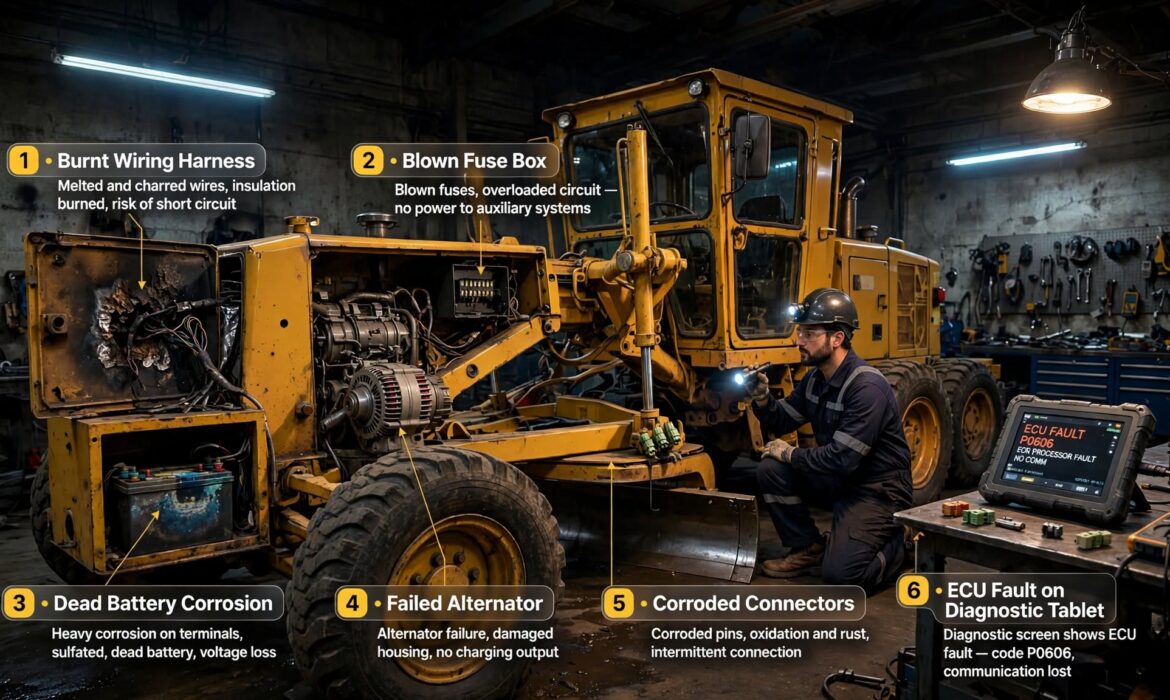
Understanding Motor Grader Electrical Failures means looking closely at the most common and ignored source. Start here. Battery terminals corrode. Dust settles on the posts. Moisture works its way in. Acid vapor escapes from the battery vents and eats into the metal.
Here is the part that catches people. That crust does not stop the machine from starting right away. It keeps starting for weeks. All that time the corrosion is choking the current, and nobody notices until the morning it finally clicks instead of cranks.
Motor Grader Electrical Failures very often begin with a terminal that needed four minutes of attention. By the time it stops cranking, the slow current has overheated the starter motor and forced the alternator to work harder. What the workshop manual does not tell you is that loose terminals are just as destructive as dirty ones. A loose clamp arcs, and arcing pits the lead post. At that point the battery is scrap.
Alternators do not usually fail all at once. They degrade. Output drops gradually, and the symptoms show up in places nobody associates with the charging system. The lights get a little dimmer at idle. The wipers slow down in heavy rain. The radio cuts out when the operator hits the horn.
Motor Grader Electrical Failures involving the charging system are among the most misdiagnosed problems in the shop. Diagnosing Motor Grader Electrical Failures correctly requires checking voltage at the battery posts. With the engine running at 1,500 RPM, it should read between 13.8 and 14.4 volts. If it reads 12.8, the alternator is mostly dead and the machine is running on battery power alone.
Belts cause a surprising number of these failures. A belt that is glazed or slightly loose will slip under load. The belt looks fine to a casual glance, but the squeal at startup was the warning sign that got ignored.
The most frustrating Motor Grader Electrical Failures come from harness damage that is invisible until something stops working. A grader has hundreds of feet of wiring running through the frame, exposed to vibration, heat, and moisture.
Motor Grader Electrical Failures from abrasion often present as intermittent faults. The machine runs fine on smooth ground, then throws a code when it hits a bump. That pattern—fault appears and disappears with vibration—almost always means a harness problem.
To prevent Motor Grader Electrical Failures, proper harness routing is essential. Rodent damage is a particular problem on machines that sit idle through winter. If you operate compact equipment as well, understanding the reliability of different TYPHON skid steer models can help you avoid these same wiring frustrations by choosing well-engineered layouts.
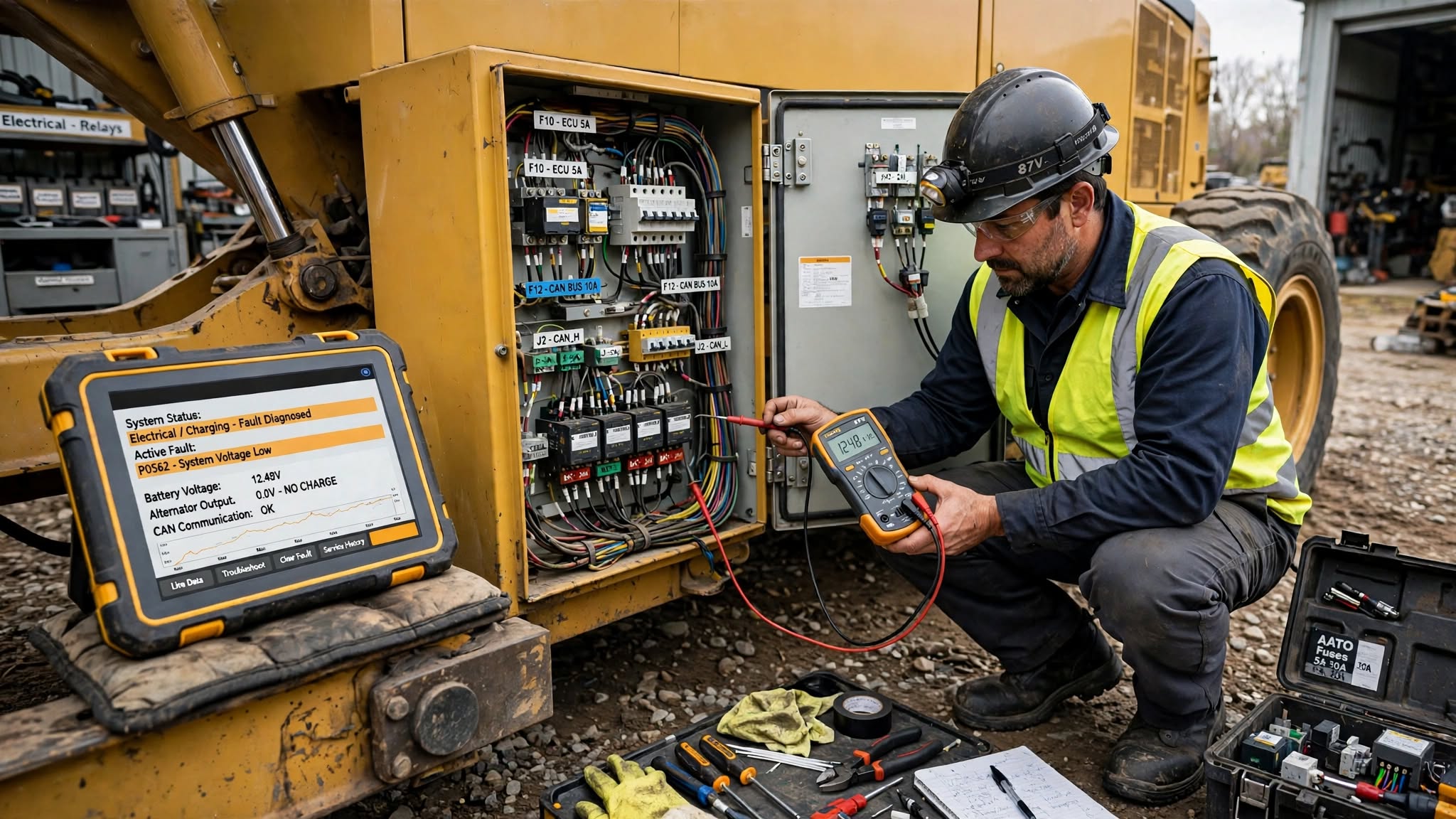
Modern graders are covered in sensors. Position sensors on the blade. Pressure sensors in the hydraulics. Speed sensors on the wheels. Every one reports back to a control module, and every one is a potential failure point.
Motor Grader Electrical Failures involving sensors are frequently solved by cleaning rather than replacement. A dirty sensor sends wrong data, and the module reacts by throwing a code. The code points at a system, not the sensor itself, sending the technician on a wild goose chase.
When Motor Grader Electrical Failures trigger sensor codes, always check the connector. The pins corrode, the plastic housing cracks, and the locking tab breaks off. A two-dollar tube of dielectric grease on the pins prevents thousand-dollar diagnostic sessions.
Motor Grader Electrical Failures involving modules are the ones that make owners wince. The ECM controls the engine, while other controllers manage the transmission and hydraulics. Each module is a computer, and each one can fail due to voltage spikes, water intrusion, or vibration.
The most expensive Motor Grader Electrical Failures involve the ECM and controllers. A replacement ECM runs into the thousands, and there is programming on top of that. The welding issue comes up more often than it should. Technicians skip disconnecting the batteries before welding, the resulting spike takes out a module, and a two-hundred-dollar welding job turns into a four-thousand-dollar nightmare.
Grounds are boring. Nobody thinks about them. And that is exactly why they cause so many problems. Every circuit needs a return path to the battery negative terminal. When a ground strap corrodes or breaks, current finds another path—sometimes through a small gauge wire that overheats and melts.
Motor Grader Electrical Failures that defy logical diagnosis very often trace back to a ground connection that nobody thought to check. The symptoms are bizarre: gauges reading wrong, lights glowing dimly, starting problems coming and going.
Resolving hidden Motor Grader Electrical Failures takes patience and testing. Simply finding every ground strap, cleaning the connection points, and tightening the bolts fixes many bizarre issues. For heavy-duty attachments requiring optimal power routing and zero electrical shorts, consider equipping your site with the reliable Typhon Stomp 501 PRO 1962 lb Skid Steer Loader.
To calculate the true cost of Motor Grader Electrical Failures, add the downtime. A starter runs $400 to $800. An alternator is $300 to $600. A wiring harness section is $500 to $1,500. Add electrical troubleshooting labor at $120 to $180 per hour.
Motor Grader Electrical Failures that get caught early cost a fraction of what they cost when the machine dies on site. On a road project with penalties for missed deadlines, a day of downtime can easily exceed the repair cost. A fleet manager proved this: before a preventive program, they averaged $38,000 annually in repairs. After, it dropped to just under $9,000.
Stopping Motor Grader Electrical Failures before they start requires daily checks. Look at the battery terminals. Watch the warning lights during startup. Listen to how the engine cranks.
Motor Grader Electrical Failures come from ordinary neglect, and ordinary attention stops them cold. Monthly tasks take an hour or two per machine: clean the terminals, test the charging voltage, and inspect the harness routing. Annual professional inspections with thermal imaging catch hot spots visually before failure.
Motor Grader Electrical Failures show themselves to anyone willing to look properly. The electrical system touches every function on the machine—lights, gauges, controls, starting, charging. Everything runs through it.
Motor Grader Electrical Failures prevention is not a luxury. It is basic equipment ownership done correctly. Maintain the system, protect the machine, and keep your budget intact.
Ready to upgrade your heavy equipment fleet for maximum reliability and uptime? We provide top-quality road building machinery shipped directly within the USA. Get a free quote from our team today.
Get a Free Quote →Heavy equipment content powered by TyphonMachinery.com