☰ Table of Contents
The moldboard pitch determines exactly how your blade cuts material. A small pitch change completely transforms your machine’s performance. The wrong pitch causes violent chattering and poor material roll, while the right pitch delivers a smooth, consistent cut.
This guide covers optimal motor grader moldboard pitch angles for 5 common materials. Operators who learn these settings finish jobs significantly faster, produce better surfaces, and reduce massive wear on cutting edges and machine components.
Perfecting your motor grader moldboard pitch starts with understanding what pitch actually means. Pitch is the forward or backward tilt of the blade. When the top of the moldboard leans toward the front of the machine, this is forward pitch. When the top leans backward toward the operator, this is backward pitch.
Most graders have a pitch indicator in the cab. A proper motor grader moldboard pitch setup forces the cutting edge down aggressively with forward pitch, or lets material roll easily with backward pitch. Our guide helps you balance these two distinct actions.
For operations using smaller machinery on tight sites, optimizing pitch is even more critical. You can learn more about matching equipment to the job in our small motor grader buying guide.
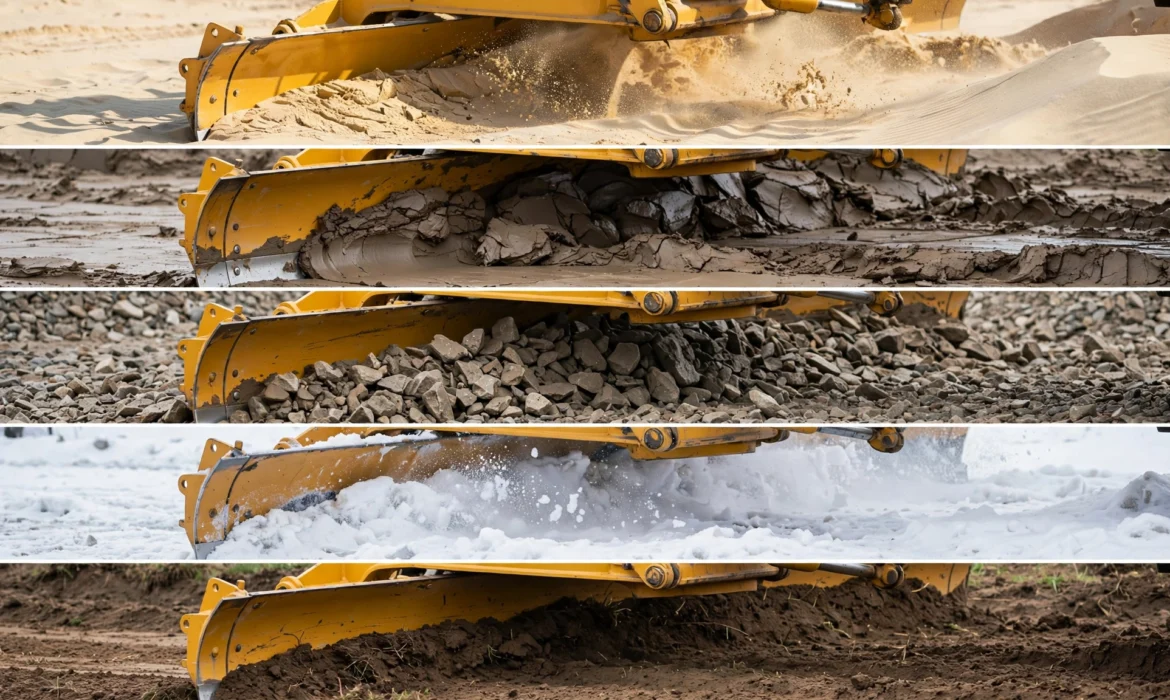
The first material setting for motor grader moldboard pitch is sand. Sand is loose, abrasive, flows easily, and does not require aggressive cutting. The correct motor grader moldboard pitch for sand is 2 to 4 degrees backward. This lets the blade skim the surface, spreading sand evenly without digging deep.
Sand grading requires a light touch. If you dig too deep, you create rolling waves in the surface that require extra passes to fix. A contractor grading a sand base for a parking lot used a 3-degree backward pitch, finishing smooth and level in one single pass.
Using the correct motor grader moldboard pitch for sand also heavily affects fuel consumption, saving 10 to 15 percent by reducing overall blade drag.
The second material setting for motor grader moldboard pitch is clay. Clay is sticky and heavy, clinging to the blade face. It requires aggressive cutting. The correct motor grader moldboard pitch for clay is 3 to 5 degrees forward.
Clay grading strictly requires cutting action. A forward pitch prevents the blade from riding over the surface, which would leave a polished, glazed finish that sheds water poorly and fails compaction tests.
A highway contractor used a 4-degree forward motor grader moldboard pitch. The blade cut cleanly through the sticky clay, leaving a rough surface completely ready for compaction.
The third material setting for motor grader moldboard pitch is gravel. Gravel is abrasive and heavy, requiring a delicate, balanced pitch. The correct motor grader moldboard pitch for gravel is 0 to 2 degrees forward. This neutral position lets the blade cut and roll material simultaneously.
Chattering indicates too much forward pitch, while material piling over the blade indicates too much backward pitch. A county road crew using a 1-degree forward motor grader moldboard pitch reduced their pass counts from 5 to 3 on a 2-mile road, saving immense time.
Improper pitch throws gravel completely off the road shoulder. A proper pitch keeps expensive gravel exactly where it belongs—on the road surface.
The fourth material setting for motor grader moldboard pitch is snow. Snow requires specific pitch angles for different winter conditions. The correct motor grader moldboard pitch for light snow is 5 to 8 degrees backward, while packed snow requires 2 to 4 degrees forward.
Light snow grading requires a gentle skimming action to prevent the blade from aggressively scraping and damaging pavement. Conversely, packed snow grading requires forward cutting action to break through the heavy, packed ice layer without violent chattering.
A municipal operator using these exact motor grader moldboard pitch settings cleared roads 20 percent faster than the previous season, saving the city significant overtime pay.
The fifth material setting for motor grader moldboard pitch is dirt. Dirt covers a wide range of varying conditions. The correct motor grader moldboard pitch is 1 to 3 degrees backward for dry dirt, 2 to 4 degrees forward for wet dirt, and perfectly 0 degrees for rocky dirt.
Dry dirt requires skimming to prevent deep ruts. Wet dirt requires aggressive forward cutting to break through sticky material. Rocky dirt requires a neutral 0-degree motor grader moldboard pitch so the blade cuts around rocks without shattering the cutting edges.
Now let us apply these motor grader moldboard pitch angles to your daily operation. Set your pitch using the cab indicator based on the material in front of you. Run a 50-foot test pass, check the material roll, and adjust immediately.
Optimal Pitch Benefits
- Smooth material roll
- 10-15% fuel savings
- Less blade wear
Pitch Errors
- Violent blade chatter
- Glazed, un-compactable clay
- Wasted shoulder gravel
Your exact motor grader moldboard pitch also depends heavily on your machine’s speed. Higher speeds require more backward pitch, while lower speeds allow for more aggressive forward pitch.
If the blade chatters, reduce forward pitch. If material piles, reduce backward pitch. Most grading problems are directly caused by improper motor grader moldboard pitch.
To ensure a flawless finish after grading, use the heavy-duty Typhon Fury 1.0 Mini Road Roller for pristine compaction on your job site.
A small pitch change transforms performance. The wrong setting wastes fuel and time. Learn these 5 angles, test them on your site, and watch your grading quality improve overnight.
Ready to upgrade your heavy equipment fleet for maximum productivity? We provide top-quality road building machinery shipped anywhere in the world. Get a free quote from our team today.
Get a Free Quote →Heavy equipment content powered by TyphonMachinery.com