☰ Table of Contents
Your equipment’s hydraulic system moves the blade, steers the machine, articulates the frame, and powers the circle rotation. When the motor grader hydraulic system troubleshooting starts, you lose production, money, and time.
This post covers 6 common failures to help you master motor grader hydraulic system troubleshooting. You will learn the symptoms, causes, and fixes. Apply this motor grader hydraulic system troubleshooting guide to your machine to reduce downtime and save repair costs.
Basic motor grader hydraulic system troubleshooting begins with oil level. Low hydraulic oil causes many problems: the machine steers slow, the blade drops, functions become sluggish, and the pump cavitates and makes noise.
Check the sight gauge daily. The hydraulic oil tank sits on the right side of most graders. Wait 10 minutes after engine shutdown before checking the level. The oil should reach the fill line. Add oil when the level falls below this mark.
The first common failure is overheating. Hot oil breaks down, loses viscosity, and damages seals. The motor grader hydraulic system troubleshooting for overheating starts with the cooler. Dirt and debris block the fins, stopping airflow. Clean the cooler fins with compressed air, blowing from the back side forward.
Overheating also comes from a clogged return filter which creates back pressure. Change your return filter every 500 hours. Your motor grader hydraulic system troubleshooting should include filter inspection. Cut open the old filter and look for metal particles, which indicate pump or cylinder wear.
Low oil level also causes overheating because there is less fluid to absorb heat. Top off the oil level daily. Your motor grader hydraulic system troubleshooting routine must include this simple check, which has reduced overheating failures by 70 percent in major fleets.
The second common failure is slow blade response. You move the joystick and the blade hesitates. Effective motor grader hydraulic system troubleshooting for slow response starts with the pilot system. Low pilot pressure gives slow response. Check pilot pressure at the test port; most graders need 400 to 600 psi.
Slow blade response also comes from a worn pump. Test pump flow with a flow meter. A flow rate below 80 percent of specification indicates pump wear. Replace or rebuild it.
Additionally, air in the system gives a spongy feel. Bleed the air by extending and retracting each cylinder fully 3 to 4 times. Your motor grader hydraulic system troubleshooting should include bleeding after any component replacement.
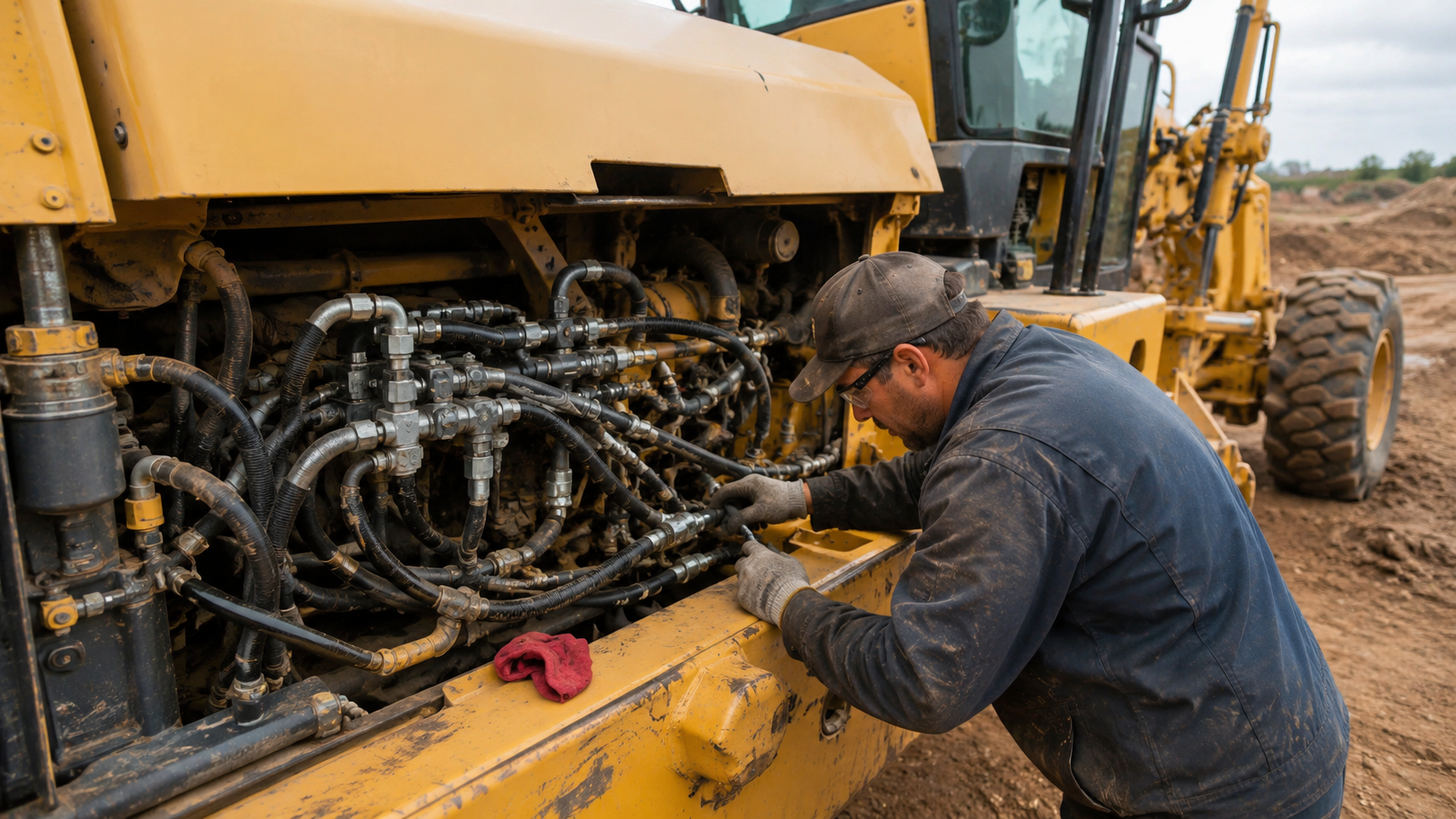
The third common failure is blade drift. You set the blade, and it drops an inch. The motor grader hydraulic system troubleshooting for blade drift points to the cylinder seals. Internal seals leak oil from one side of the piston to the other, causing the blade to drop. Rebuild the cylinder with new seal kits before buying a $2000 replacement.
Blade drift also comes from bad valves. Test valve leakage by capping the cylinder ports. If the blade does not drift with capped ports, the valve is faulty.
External leaks cause blade drift too. Your motor grader hydraulic system troubleshooting should include rod inspection. Polish minor scratches with a fine emery cloth, and replace rods with deep scratches.
The fourth common failure is hard steering. The wheels turn slowly or incompletely. Advanced motor grader hydraulic system troubleshooting for hard steering starts with the steering orbital motor. Worn internal parts reduce flow. Replace or rebuild it with a kit.
Hard steering also comes from a bent rod binding in the steering cylinder. Inspect the rod for straightness and hone scored bores to smooth the surface.
Low pilot pressure causes hard steering too. Your motor grader hydraulic system troubleshooting must include pilot pressure checks for steering issues. Adjust the pilot relief if pressure is low.
The fifth common failure involves the circle. It rotates slowly or not at all. Targeted motor grader hydraulic system troubleshooting for circle rotation starts with the circle drive motor. Worn parts reduce torque, so replacing or rebuilding the motor is necessary.
Rotation problems also stem from the circle bearing. Worn wear strips let the circle drop, increasing friction. Your motor grader hydraulic system troubleshooting should include wear strip inspection every 500 hours.
Inspect the gear teeth through the inspection port as well. Chipped or missing teeth require a major repair to replace the gear.
The sixth common failure is erratic blade movement. The blade jumps or shakes. Detailed motor grader hydraulic system troubleshooting for erratic movement points to contaminated oil. Dirt sticks to valve spools. Change the oil, replace filters, and flush the system if necessary.
Erratic movement also comes from loose electrical connections in modern electronic joysticks. Your motor grader hydraulic system troubleshooting for electronic controls requires a multimeter. Test for voltage at the valve solenoids; low voltage indicates wiring issues.
If a failing solenoid sticks, the valve opens randomly. Test the solenoid resistance with an ohmmeter and replace it if it falls outside the manufacturer’s spec.
Now let us put together a motor grader hydraulic system troubleshooting routine. Start every morning by checking the sight gauge for oil level and color. Dark oil indicates overheating, while milky oil indicates water.
- Check the hydraulic oil temperature after 1 hour (Target: 140 to 180 degrees Fahrenheit).
- Change oil every 2000 hours and return filters every 500 hours.
- Keep a motor grader hydraulic system troubleshooting log to track failures and predict future pump or valve replacements.
Train your operators in motor grader hydraulic system troubleshooting so they catch symptoms early. One contractor trained his entire crew on motor grader hydraulic system troubleshooting and dropped repair costs from $45,000 to $15,000 in a single year.
If you want to prevent these issues from the moment you turn the key, review our guide on the proper motor grader start up and shut down procedure.
For smaller trenching or excavation needs alongside your grading project, the Typhon Terror XVII Pro 3800 lb Mini Excavator is a perfect companion machine.
These simple motor grader hydraulic system troubleshooting steps will save you money, preserve your machine, and keep your operators safe and productive.
▶ Hydraulic System Walkthrough – Watch It Work
Ready to upgrade your heavy equipment fleet with reliable machinery? We provide top-quality road building equipment shipped anywhere in the world. Get a free quote from our team today.
Get a Free Quote →Heavy equipment content powered by TyphonMachinery.com